How much a restaurant website really costs
Every quote is made of the same four parts: the build, the upkeep, the cut on each sale and the domain. Price each one for a full year.
A restaurant website costs four things: the build, the hours someone spends keeping it current, any cut taken from orders or bookings made through it, and the domain. Price all four for one full year, using your busiest month for the cut, before you compare quotes. The cheapest launch price is often not the cheapest year.
- Price the build, the upkeep, the cut and the domain.
- Use your busiest month to price any per-sale fee.
- Register the domain in your own name.
- What you pay for
- Build, upkeep hours, per-sale cut, domain
- Easiest to miss
- Upkeep hours and per-sale fees
- Price the cut on
- Your busiest month, not an average
- Free builder plans
- Their subdomain; own domain needs paid plan
- Tableify billing
- A flat monthly price
- Tableify hosting and setup
- Hosting included, built for you
Before you pay for anything new, see what your current site shows guests, search engines and AI assistants, next to places nearby.
- 1.The Thai kitchen on Oak Street
- 2.The noodle house by the library
- 3.The street food bar downtown
Price the build, whoever does it
The build is the part every quote leads with. There are three ways to get it: build the site yourself on a general website builder and pay with your evenings, hire a designer or an agency and pay up front, or pay a monthly plan to a company that builds the site and keeps it running.
Ask each one exactly what the build includes: how many pages, whether the menu is typed in for you, whether photos are part of it, and whether booking, ordering and gift cards come built in or are bolted on later.
Count the upkeep hours
A site is never finished. The menu changes, holiday hours come and go, a dish sells out, a new event goes up. Someone has to make each change, and their time is a cost even when no invoice arrives for it.
List the changes a normal month brings, guess the minutes each takes, and put a price on the hour. Then ask each option who makes those changes and how fast. The menu matters most, because it is what guests and assistants read first; the menu SEO guide explains why it should be text.
- 1.The Thai kitchen on Oak StreetFull menu with prices, spice levels marked.
- 2.The noodle house by the libraryLunch specials listed, order ahead online.
- 3.The street food bar downtownSmall plates, vegan dishes marked on the menu.
Find the cut on every sale
The line that grows fastest is often not the website at all. A percent of every online order, a fee for every booking or cover, a cut of gift card sales: each one is small on the day you sign and larger on every good night after.
Ask each option to list every per-sale fee and who pays it, then price them on your busiest month, not an average one. The online ordering page works through a sample, and the reservation system checklist covers booking fees.
A short call. We look at what your site has to do and give you an exact price for ours.
Own the domain and the address
The domain is the cheapest part and the most expensive to lose. Free plans on general website builders run on the builder's own subdomain and carry its ads; using your own domain needs a paid plan. Some builders and designers also register the domain in their own name on your behalf.
Register it in your restaurant's name, keep the login, and give your web company access instead. Your Google listing, printed menus and QR codes all point at that address, so it has to move with you.
Add up one full year
Now put the four parts side by side for twelve months: the build or setup, the upkeep at your hourly price, the per-sale fees at your busiest month, and the domain. Use the full price after any first-year discount, and add any paid apps for booking, ordering or event forms.
Only then compare. A low monthly price with a percent of every order can cost more over a year than a higher flat price with none, and the scorecard below shows where a quote is still hiding something.
What will your site really cost you?
Tick each line that is true of the quote in front of you. Your ticks stay on this page.
Most of this year's cost is not in the quote. Ask for the upkeep, the per-sale fees and the domain in writing, or book a short call and we will walk through it with you.
The build: what a launch price covers
Building it yourself sends a small monthly bill and a large hidden one: your time. You pick the template, write the pages, take or buy the photos, and type in the menu, dish by dish. General builders are made for every kind of business, so booking, ordering and gift cards usually arrive as separate apps with their own bills.
A designer or an agency sends one large bill at the start and smaller ones after it: hosting, a care plan, and an hourly rate for changes. A monthly done-for-you plan folds the build into a steady bill, often with a setup fee. With every option, the honest question is the same: what exactly is built, and what will you still have to add?
The upkeep: hours nobody puts on the quote
Upkeep is the part owners price last and pay for longest. A normal month at a busy restaurant can bring a new seasonal dish, two price changes, a sold-out item, a holiday closing, a private event to promote and a patio that opens or shuts. Each is a few minutes for someone who knows the site, and an evening for someone who does not.
When nobody makes those changes, the cost moves to the guest. They read last season's menu, show up on a closed holiday, or call to ask what an assistant could have read on the page. Count the hours honestly, decide who will spend them, and price them in. If the answer is you, after service, write that down too.
The cut: fees that rise with every busy night
A fixed monthly price is easy to judge. A fee on each sale is not, because it is tiny on the day you sign and grows with your best nights. It can be a percent of every online order, a fee for every booked cover, a share of each gift card, or a fee on a deposit. Some are paid by the restaurant and some are added to the guest's bill, and both change what an order or a booking is worth to you.
Ask each option for every per-sale fee in one list, with who pays it, and price it on your busiest month last year. On Tableify there is no commission on bookings, deposits, gift cards or event payments. On some plans a flat fee per online order is paid by the guest, and the top plan has none. Gift card money goes straight to your own account; the gift card page shows how.
Type your restaurant's name. The free report shows how you come up on Google and in AI answers, next to the places near you.
The domain: cheap to buy, costly to lose
A domain costs little each year, which is why it gets handed to whoever builds the site. That is the risk. If the builder holds the registration, leaving them can mean losing the address that your Google listing, your printed menus, your QR codes and years of links all point to.
Free website plans add a second catch: they run on the builder's own subdomain and show its ads, and putting the site on your own domain needs a paid plan. Count that upgrade in the year's cost. Whoever builds the site, register the domain in your restaurant's name, keep the login, and give them access. Then a switch later is an afternoon of work, not a new address.
What leaving would cost you
The cost of a website includes the cost of getting out of it. Before you sign, ask what happens to each thing the site holds if you leave: the domain, the words, the photos, and the guest records from bookings, orders, gift cards and event inquiries. Ask how long the contract runs and what ending it early costs.
These answers belong next to the price, because they change what the price really is. A cheap site you cannot take with you can become the most expensive one the day you outgrow it. Ask who owns the photos from any shoot that comes with a plan, and whether you can export the guest list at any time.
One row per quote
Quotes arrive in different shapes: one monthly, one up front, one with the fees on a separate pricing page. Rebuild each into the same columns and the comparison does itself. Leave a cell blank when a quote does not say, and ask about every blank before you sign.
- Build or setup: one-time cost, the pages it covers, and any photo shoot.
- Monthly price for twelve months, at the full price after any first-year discount.
- Paid apps for booking, ordering, gift cards and event forms, each priced monthly.
- Per-sale fees in your busiest month, with who pays each one.
- Upkeep hours per month, times what an hour costs you.
- The domain: whose name it is in, and the cost of a paid plan to use it.
Where a Tableify plan fits in the four
A Tableify plan is a flat monthly price. The build is done for you in two to four weeks from your menu, rooms, photos and story, and hosting is included. Upkeep is yours to do from your account in minutes, hours, menus, specials and the announcement bar, or you send the change to our team in plain words. Booking, gift cards, event inquiries and online ordering live on the same site, depending on the pieces you turn on.
There is no long contract; you can cancel anytime. Annual plans waive the setup fee and include a photo shoot. Plans and prices are on the homepage rather than here, because the right plan depends on what your site has to do. The website builder page walks through the weeks before launch, and the website checklist helps you decide what your site needs.
What the build should include
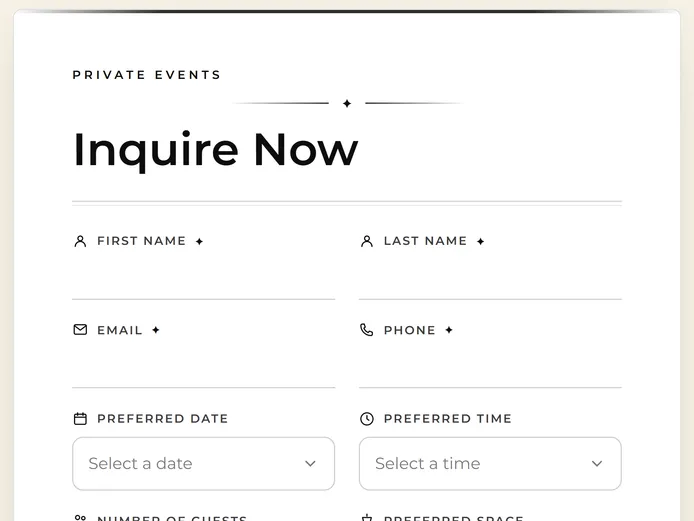
Sample pages from Tableify demo sites with made-up restaurants, and a real inquiry form from a restaurant on Tableify.
Questions about website cost
How much does a restaurant website cost?
It depends on four parts: the build, the upkeep hours, any cut taken from orders or bookings, and the domain. Price all four for a full year, using your busiest month for the per-sale fees. We do not print market price ranges, because the same site can cost very different amounts depending on who keeps it current and what it charges on each sale.
Can I make a restaurant website for free?
You can start one free on many general website builders. Free plans run on the builder's own subdomain and show its ads, and using your own domain needs a paid plan. Booking, ordering and gift cards usually cost extra, and the hours to keep the menu current are yours. Count all of that before you call it free.
How much should a small restaurant pay for a website?
Enough that the site does the jobs guests need and someone keeps it current, and no more. List what yours must do, then compare every option over a full year with upkeep and per-sale fees included. A site that books parties or sells gift cards should be judged against what it brings in, not only against its price.
What hidden fees should I look for?
A percent of online orders, a fee per booking or per cover, a cut of gift card sales and a fee on deposits. Also look for the renewal price after a first-year discount, paid apps for booking or event forms, and a domain held in someone else's name. Ask for all of them in one list, with who pays each.
How much does a Tableify website cost?
Tableify is a flat monthly price with no commissions, and the plan depends on which pieces you turn on. Hosting is included, and annual plans waive the setup fee and include a photo shoot. Plans and prices are on the homepage, and a short call gets you an exact number for your restaurant.
Is it cheaper to build my restaurant website myself?
The bill is smaller, the hours are not. You write the pages, type in the menu and come back for every change, usually after service. If you enjoy that and keep it current, it can be the cheapest year; if the site goes stale, guests pay for it in wrong hours and old prices.
Who should own my restaurant's domain?
You should. Register the domain in your restaurant's name, keep the login, and give your web company access rather than letting it hold the domain for you. If you ever switch, a domain you own moves with you, and your Google listing and printed menus keep pointing at the right address. The Google Maps guide covers keeping the listing's links right.
Price the year, not the launch.
Before you compare quotes, see what your current site misses with guests, on Google and in AI answers. Free, about a minute.